Debunking America’s Biggest Myths About AI

The reality behind AI adoption, behavior, and trust — and what it means for marketers
Artificial intelligence (AI) has rapidly evolved from a niche innovation into a mainstream behavior shaping everyday life in the United States. In just a few short years, adoption has surged dramatically, with 70% of U.S. adults now using AI tools, up from 62% in 2025 and 53% in 2024. This exponential growth reflects not only increased accessibility but also the normalization of AI across personal and professional contexts. What was once considered experimental technology is now embedded in workflows, entertainment, decision-making, and even emotional support.
Yet despite this widespread adoption, misconceptions persist about who is using AI, why they’re using it, and how they feel about it. These myths can lead marketers and media planners to overlook critical audiences or misinterpret consumer sentiment. Let’s break down the biggest myths and realities advertisers need to understand to stay ahead.

Who’s using AI, how they’re using it, and how they feel about it don’t always align with expectations.

MYTH #1
"AI Is Just for the Young, Educated, and Tech-Savvy"
The truth is: The idea that AI is reserved for a tech-savvy elite no longer reflects reality.
- While it’s true that adoption skews higher among younger generations (over 80% of Gen Z and Millennials use AI tools), usage across older groups is still remarkably high, with 68% of Gen X and 50% of Boomers actively engaging with AI.
- Education also fails to be a limiting factor: 75% of adults with a bachelor’s or postgraduate degree use AI, but so do 67% of adults who did not graduate high school.
- Similarly, AI use is not confined to employment status. 85% of college students use AI, but 57% of unemployed adults and 48% of retired adults are also users.
- Occupational diversity further challenges the stereotype, as 86% of computer professionals and 84% of healthcare practitioners use AI, alongside 84% in military roles, 82% in arts and entertainment, 79% in social services, 78% in legal, 76% in food service, and 72% in construction.
This breadth of adoption illustrates that AI has grown from being a niche tool to a universal one. For advertisers, this means audience segmentation based purely on demographics or profession risks missing a substantial portion of AI-engaged consumers. AI usage is less about identity and more about accessibility and curiosity, making it a cross-cutting behavior rather than a niche segment.
MYTH #2
“AI Is Mainly a Work and Productivity Tool”
The truth is: While productivity remains a key function, consumer behavior tells a much broader story.
- On the functional side, 20% of U.S. adults use AI to summarize information, 13% to create content, and 13% for daily task management, while 12% use it for coding or other hard skills, 11% for tech troubleshooting, and 8% for meeting management.
- However, 20% of adults use AI simply to play around and experiment, signaling curiosity as a major driver of adoption.

- Beyond that, 14% use AI to explore health concerns, while 13% edit photos, generate images or videos, and even create recipes.
- Lifestyle integration continues with 12% using AI for travel planning, 10% creating course content to learn something new, and 9% turning to AI for mindfulness or emotional support.
These behaviors reveal that AI, originally positioned as a utility, has become a companion throughout everyday life. Brands that tap into AI’s role in creativity, entertainment, and self-improvement can connect with consumers in more personal and engaging ways.

MYTH #3
“People Are Fully Trusting and Optimistic About AI”
The truth is: High adoption does not equal blind trust. Rather, skepticism is deeply embedded in the AI user mindset.
- While 52% of U.S. adults are open to using AI at work (rising to 68% among current AI users), and 52% believe AI tools are safe (66% among users), confidence drops when it comes to deeper reliance.
- Only 48% would trust AI insights from their smartwatch for health decisions (61% among users), and 43% feel comfortable relying on AI for all future information needs (56% among users).
- At the same time, concerns around transparency and ethics are widespread. 81% of adults believe AI needs to be carefully managed, and 81% say AI-generated content must be clearly labeled.
- Consumers are also demanding accountability, with 80% wanting transparency in how companies use AI and 78% expecting clarity on how their data is stored and used.
- Traditional behaviors still hold weight, as 76% prefer search engines over AI tools because they can control their sources, while 75% are concerned about AI’s societal impact.
- Emotional reactions further underscore this skepticism: 66% are bothered when they learn content was AI-generated, 65% trust physical ads more because they can’t be manipulated, and 56% fear AI will replace their jobs.
For advertisers, this dual reality of high usage paired with high skepticism means messaging must balance innovation with trust. Transparency, authenticity, and clear labeling are no longer optional; they are critical to maintaining credibility.
MYTH #4
“Non-Users Have Rejected AI Entirely”
The truth is: non-use frequently stems from uncertainty or lack of relevance rather than outright rejection.
- Among the 30% of U.S. adults who are non-users of AI, 19% still believe AI tools are safe, and 17% feel confident using AI integrated into their devices.
- Similarly, 15% are open to using AI at work, and 13% would even feel comfortable relying on it for future information needs, indicating trust still exists among non-users.

- Importantly, there’s still demand for AI-powered experiences. Over 20% of non-users want brands to offer AI on their websites for faster customer service, and 16% would trust AI insights from a smartwatch for health decisions.
- Even product expectations show emerging interest among AI non-users, with 13% saying it’s important that their next car includes AI technology.
- Non-users’ concerns are also more muted compared to AI users: 68% worry about AI’s societal impact (vs. 78% of users), 60% are bothered by AI-generated content (vs. 69%), and 45% fear job replacement (vs. 61%).
This suggests that non-users are not necessarily disengaged. They’re simply earlier in the adoption curve. For marketers, this group represents a high-potential audience that can be activated through education, accessibility, and clear demonstrations of value.
Why Advertisers Must Engage Both AI Users and Non-Users Differently
The story of AI in America has moved beyond simple adoption to complexity, contradiction, and opportunity. With 70% of adults already using AI in their daily lives, the audience is undeniably massive, but it’s also highly nuanced, spanning demographics, professions, and levels of trust. AI users are curious, experimental, and engaged, yet they demand transparency and remain cautious about overreliance. Non-users, meanwhile, are not entirely resistant but rather waiting for clearer value propositions and more intuitive experiences.
For advertisers, this creates a dual opportunity. AI users can be reached with innovative, personalized, and experience-driven campaigns that align with their exploratory behavior. Non-users, on the other hand, require reassurance, simplicity, and practical use cases that demonstrate how AI can improve their lives. Brands that recognize and act on these differences will be best positioned to build trust, capture attention, and drive meaningful engagement in an AI-shaped future.

The real opportunity with AI lies in identifying how different audiences engage, what they trust, and where they’re ready to act.
Activate AI Audiences with MRI-Simmons
Leverage MRI-Simmons data to create the right audience for your next campaign
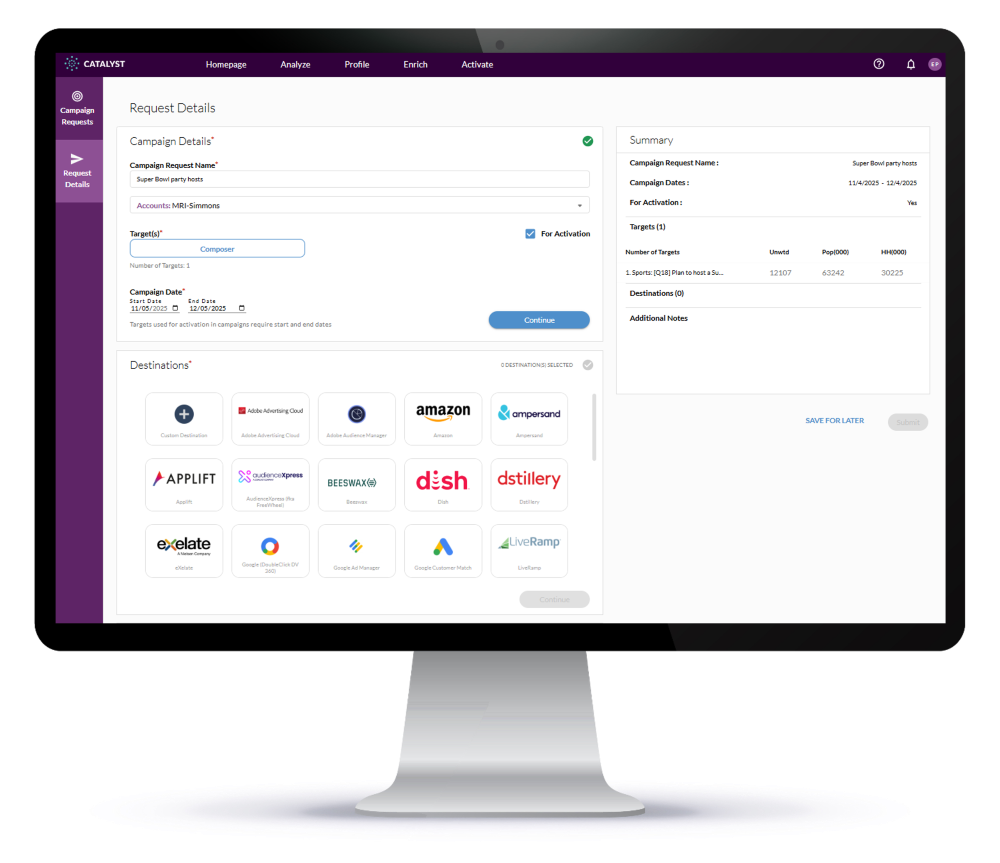
Through MRI-Simmons' activation solution, ACT, marketers can leverage trusted and nationally representative data to target and reach ChatGPT Daily Users, AI Non-Users, auto consumers wanting AI features, consumers who trust AI health insights, one of our 100s of off-the-shelf targets, or any target of your choice.
Curate your audience with over 60,000 consumer elements: 1000+ attitudes and opinions, 6500+ brands in 1000+ product categories; and 90+ proprietary segments. Then, activate your audience via the ad-tech platform or media partner of your choice.
Source: MRI-Simmons 2026 May Digital Life Study (W26 USA). Base: U.S. Adults 18+