What Marketers Get Wrong about Cord Cutters

Four Persistent Myths About Cord Cutters
Cord cutters represent a large, older, and affluent audience that has embraced streaming yet remains highly reachable via ad-supported channels. Their viewing behavior creates fertile ground for efficient reach and incremental frequency.
To adapt to the new TV landscape, leading marketers are now harnessing streaming video to engage consumers through new ad formats, sequential messaging, and cross-screen targeting capabilities that linear can’t match.
To take full advantage of the growing number of streaming viewers, marketers must understand the nuances of today's audiences and adapt quickly.

37% of U.S. adults (97 million) have cut the cable cord, up from 25% (64 million) five years ago.

Below are the top four myths about cord cutters, and the truth that marketers need to adapt to:

MYTH #1
"Young People are leading the cord cutting shift"
The truth is: Adults ages 45-54 (with a median of 48) are 31% more likely to cut the cord than other age groups.
- That this age group overindexes for dropping cable is a powerful signal of a mainstream and mature behavior, not niche and youthful.
- Nearly half of Gen X (46%) have already cut the cord, and even one third of Boomers (33%) have made the switch.
- This older skew pairs with spending power: cord cutters bring home a median household income of $104K, which is 9% higher than average, making them prime targets for premium categories from finance to travel to auto.
- Meanwhile, a parallel trend is reshaping the bottom of the funnel: 25% of U.S. adults have never had a cable subscription. Among these cord “nevers,” over half (55%) are under age 35, and nearly half of Gen Z (45%) have never entered the cable ecosystem at all.
The takeaway? If your media mix is anchored to linear, you’re missing the a growing number of Gen X/Boomers and never reaching a younger Gen Z cohort, who don't watch cable TV.
MYTH #2
"Cord cutters regret leaving and will eventually come back”
The truth is: The data says the exact opposite.
- Among the 97 million adults who have cut the cord, less than 8% regret it. 92% have no intention of resubscribing to a cable or satellite TV package, which means “winback” strategies via linear are largely wishful thinking.
- Their satisfaction is tied to control and quality: 86% like being able to watch the next episode immediately after finishing one, and 80% don’t mind waiting until a TV network’s show hits a streaming service.
- There’s a perception premium, too: 71% agree streaming services create the best shows, suggesting that content quality is now strongly associated with streaming environments.
- While cost matters, value perception is strong: 56% agree subscribing to streaming services is worth the money.

The takeaway? For advertisers, this means investing in streaming placements isn’t merely following audience migration. It’s aligning with where viewers prefer to watch, binge, and talk about shows.

MYTH #3
“Cord cutters are harder to reach with ads”
The truth is: 94% of cord cutters stream video on an ad-supported service, giving advertisers abundant targetable inventory.
- Preference tilts toward ad funded models: 68% prefer streaming free video content with ads instead of paying for ad free tiers.
- Platform reach is broad and specific: 56% stream on YouTube with ads, 47% stream on Prime Video with ads, and 31% stream on Tubi, creating a diversified canvas for frequency and creative sequencing.
- Time allocation echoes this ad friendly stance. Cord cutters spend 52% of their streaming time on ad supported services or FAST channels, while only 24% goes to ad free platforms.
- Importantly, this audience shows meaningful ad engagement. 38% think streaming ads are relevant, 33% like when ads are interactive, and 31% say ads are more memorable when seen while streaming.
The takeaway? Streaming environment offers reach AND receptivity that can drive brand lift and action.
MYTH #4
“Cord cutters only use one or two streaming services”
The truth is: Choice fragmentation is the new norm, and cord cutters are power users.
- Less than 15% (14 million) use only 1–2 streaming services or apps, which means most households are reachable across multiple publishers.
- A meaningful middle swath (27% or 26 million) use 3–5 services, where media planners can effectively manage frequency with smart capping and crossplatform measurement.
- The plurality is even heavier: 32% (31 million) use 6–10 services, reflecting a lean in, content first behavior that rewards creative rotation and contextual adjacency.
- And the superstackers are real: 23% (22 million) use 11 or more services or apps, an opportunity for advanced audience deduplication and sequential storytelling across CTV, mobile, and desktop.

The takeaway? Your plan should be built for breadth plus orchestration: a mix of broad reach ad supported platforms, FAST channels, and selective premium AVOD, reinforced by consistent identity and measurement to unify the journey.
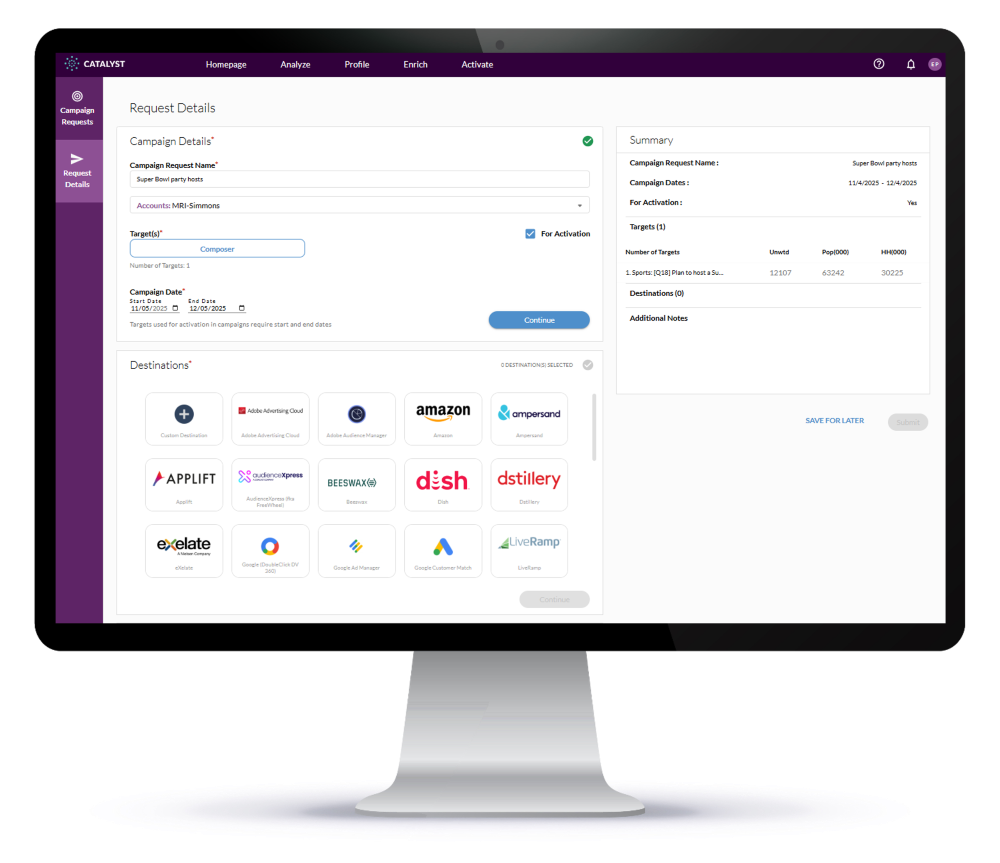
Activate Streaming Audiences with MRI-Simmons
Target the right audience for your next campaign with MRI-Simmons.
Through MRI-Simmons' activation solution, ACT, marketers can leverage trusted and nationally representative data to target Cord Cutters, Cord Loyalists, Cord Nevers, or any other custom target based on a wide variety of media habits.