The Video Podcast Boom is an Evolution, Not a Takeover

MRI-Simmons data shows that video podcasts are expanding podcast reach and branding without disrupting deep-rooted audio listening habits.
Over the past few years, video podcasts have exploded across video platforms and social feeds, prompting a familiar industry question: is video replacing audio? The data say no.
- 74% of podcast listeners agree that video podcasts are an enhancement to audio-only formats, not a replacement, reinforcing that the core value of podcasting remains intact.
- Having both formats available matters to 67% who say it’s important (and 29% call it very important) that podcasts offer audio and video options.
- While 66% say they would prefer to watch the video version if offered, this preference doesn’t come at the expense of audio loyalty.
- Among those who prefer video, 95% still listen to audio podcasts, and 78% do so weekly, underscoring that video-first fans remain deeply audio-engaged.

Podcasts are evolving into media brands without losing
their rootsWhat is a podcast these days, anyway?
Despite the rise of video, audience perception continues to ground podcasts in audio.
- 50% of podcast listeners still define a podcast as an audio program or spoken-word content that’s not traditional radio, compared with just 13% who define podcasts as video programs.
- 15% are open to podcasts being any creator-led show they follow online (audio or video), and 14% think podcasts are whatever is labeled as a “podcast”.
- Another 8% say they’re not sure how to define a podcast anymore, signaling an industry in transition but not in crisis.
These definitions matter because they shape expectations for advertisers, creators, and platforms alike. Audio remains the default mental model, even as video layers on top. That ambiguity creates flexibility, allowing brands to innovate without alienating core listeners.

Context determines format
Usage patterns show how audio and video complement each other across daily routines.
- 78% of podcast listeners listen to audio programs weekly, compared with 68% who watch video programs weekly, indicating that audio still holds a slight edge in habitual use.
- Both weekly listeners and weekly viewers follow an average of five different podcast programs and consume about four programs in a typical week, showing that engagement levels are remarkably similar.
- Time spent on podcasts is also comparable: weekly listeners average about 6 hours and 45 minutes, while weekly viewers average just over 7 hours per week.
- Context is the key differentiator. Weekly listeners are more likely to consume podcasts while exercising and driving, while weekly viewers are more likely to tune in while relaxing at home.
- Video podcasts are more of a social experience for weekly viewers, who are 12% more likely than weekly listeners to enjoy episodes with a spouse and 24% more likely with a friend.
- Content categories further explain the split: weekly viewers are 13% more likely to consume religious podcasts, 12% more likely to consume leisure content, and 11% more likely to consume science and tech podcasts, genres that often benefit from visual cues.
Audio loyalty holds strong, even on Video platforms
Even video environments don’t automatically turn listeners into viewers.
Growth in video consumption reflects distribution expansion, not cannibalization, as audiences follow content wherever it’s most convenient. Listeners are choosing when video adds value and when audio alone fits better, and video has become a discovery and accessibility layer for some. For advertisers, that means incremental reach rather than audience migration.

55% of podcast listeners now consume podcasts on YouTube...up from 38% in 2022, representing a 45% increase in four years

53% of podcast listeners say they usually ignore the video and just listen to the audio ... treating YouTube like a flexible listening platform rather than a visual one
Seeing the host deepens the brand but doesn’t change behavior
One promise of video podcasts is stronger creator connection, and the data show modest but meaningful lifts.
- Weekly viewers are 7% more likely than weekly listeners to post about the podcast on social media, amplifying organic reach beyond the feed.
- They’re also 6% more likely to be interested in buying podcast merchandise, suggesting video can strengthen brand affinity.
- At the same time, viewers show slightly more casual consumption behavior, as they’re 11% more likely to only consume a few minutes of an episode.
- Importantly, video doesn’t dramatically change long-term commitment signals: viewers are only 3% more likely to want to attend live podcast events and just 2% more likely to be interested in podcast email newsletters.
These narrow gaps indicate that video enhances brand experience without fundamentally altering loyalty mechanics. For marketers, that balance means more touchpoints without dilution.
Why advertisers should design for both ears and eyes
Video podcasts are expanding the ecosystem, not eroding it. Audio continues to dominate commuting and workouts, while video unlocks at-home viewing, visual storytelling, and social amplification. Listeners aren’t abandoning audio when video appears. They’re layering it into their habits, often within the same week.
For advertisers, this means the biggest opportunity lies in designing campaigns that work natively across both formats. Brands that optimize sound, sight, and context can meet audiences wherever attention naturally flows. The future of podcasting belongs to marketers who recognize that listeners and viewers aren’t competitors; they’re often the same people, just at different moments.
Activate Podcast watchers & listeners with MRI-Simmons
Leverage MRI-Simmons data to create the right podcast audience for your next campaign
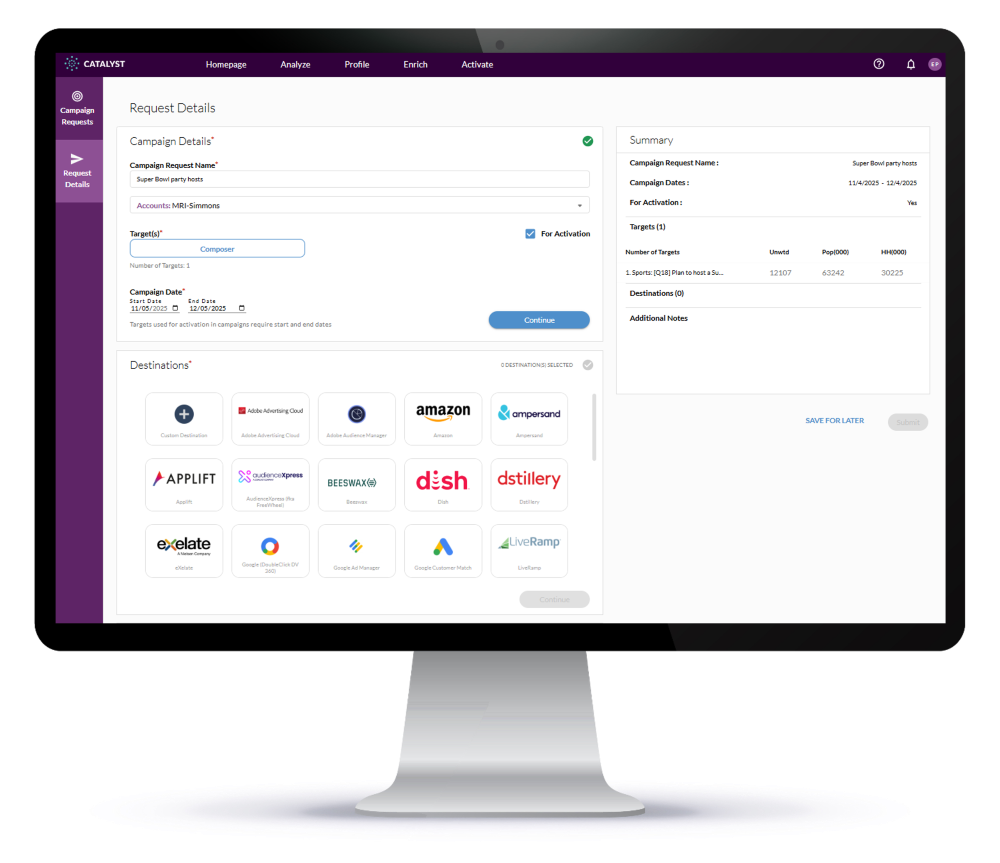
Through MRI-Simmons' audience activation platform, marketers can leverage trusted, nationally representative consumer insights to create and target podcast watchers, listeners, or any combination of the two.
Audiences can be curated from over 60,000 consumer attributes, including 1000+ attitudes and opinions, 6500+ brand preferences, shopping styles, and media habits.
Audiences can be seamlessly activated through the ad-tech platform or media partner of your choice.
Source: MRI-Simmons 2026 April Podcast Study (F25 USA). Base: Podcast listeners P30 days.